The Omnipresence Framework: Why AI Cites What It Finds Everywhere
The four surfaces that determine whether AI recommends you—or your competitors. A strategic framework for building AI visibility through multi-channel presence.

Author
"How do I get ChatGPT to recommend my brand?"
This is the question we hear most often. And the answer most people give—"optimize your content for AI"—is wrong.
Not wrong because optimization doesn't matter. Wrong because it misses the fundamental shift in how AI systems decide what to cite.
You can't optimize your way to AI citations if you only exist on your own domain.
AI models are trained on the entire web. They synthesize answers from multiple sources. When someone asks "What's the best tool for X?" the AI doesn't just consult your website. It looks at Reddit discussions, comparison articles, industry publications, expert mentions, and community recommendations.
The brands that appear everywhere become the default answers. The brands that exist only on their own websites become invisible.
This is the insight behind the Omnipresence Framework.
The Core Insight: AI Cites What It Finds Everywhere
Here's a statistic that should change how you think about AI visibility:
97.2% of AI citations are NOT explained by backlinks alone.
That's from GrowByData's research on citation patterns. The traditional SEO playbook—build domain authority through backlinks—doesn't translate directly to AI visibility.
What does predict citations? Presence across multiple platforms.
According to Search Engine Land's analysis of 8,000 AI citations, brand mentions correlate 3x more strongly with AI visibility than backlinks.
The mechanism is straightforward: AI models are trained to synthesize from diverse sources. A brand mentioned only on its own website looks self-promotional. A brand mentioned across Reddit, industry publications, comparison sites, and expert analyses looks credible.
Single-channel excellence loses to multi-channel presence.
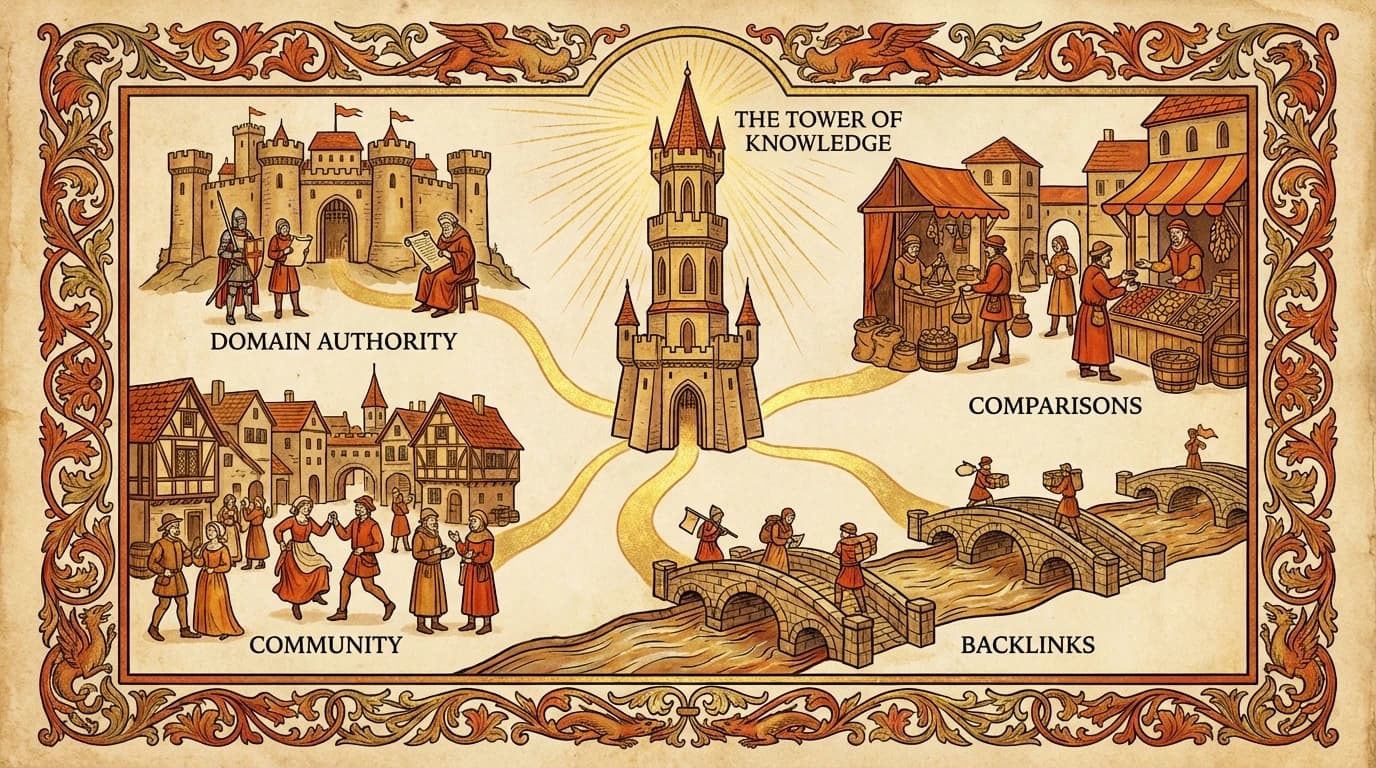
The Omnipresence Framework: Four Surfaces
We've mapped where AI actually looks when answering questions about products, services, and brands. There are four distinct surfaces, each weighted differently depending on the query type.
| Surface | What It Includes | Citation Impact |
|---|---|---|
| Domain Authority | Your website, blog, resource center | Foundation—necessary but not sufficient |
| Community Presence | Reddit, Quora, forums, discussions | High—validates real-world credibility |
| Comparison Inclusion | Listicles, review sites, roundups | Critical for commercial queries |
| Backlink Profile | Editorial coverage, expert mentions | Authority signal that compounds others |
The Omnipresence Framework is a strategic model for building AI visibility through consistent presence across all four surfaces. Each surface alone is insufficient. Together, they create what we call citation gravity—the accumulated authority that makes AI systems more likely to cite you.
Surface 1: Domain Authority (Your Foundation)
Domain authority is where most brands start—and where many stop. Your website, blog, resource center, and product pages form the foundation of your online presence.
AI systems verify entity existence through domain presence. Without a credible domain, the other surfaces have nothing to anchor to. E-E-A-T signals (Expertise, Experience, Authoritativeness, Trustworthiness) originate here.
The trap: Many brands invest heavily in content, schema markup, and technical SEO, then wonder why AI still doesn't cite them. Great content is table stakes. It's not the game.
Key optimizations:
- Schema markup: Implementing structured data (JSON-LD) improves LLM discoverability by 67%
- Answer capsules: 72% of pages cited by ChatGPT have a direct answer in the first paragraph
- Freshness: Content updated within 30 days gets 3.2x more AI citations than stale pages
- Clear entity definitions: State who you are, what you do, in the first 100 words
Domain authority is the foundation. But a foundation isn't a building.
Surface 2: Community Presence (The Validation Layer)
This is where most brands are weakest—and where the opportunity is largest.
Reddit appears in 68% of AI Mode results. Semrush research found that Reddit generates a 121.9% citation frequency in ChatGPT responses—meaning it's referenced more than once per prompt.
Why does AI weight community content so heavily?
Because community discussions represent real human validation. When someone asks Reddit "What accounting software should I use for my freelance business?" and twenty people recommend the same tool, that's a credibility signal no amount of self-promotional content can match.
The counter-intuitive insight: You may not need to rank #1 on Google. You need to be mentioned by the people who do.
If a comparison article ranks well and doesn't include your brand, you're invisible for that query—no matter how good your website is. But if community discussions consistently recommend you, AI picks that up.
What to include:
- Reddit participation in relevant subreddits
- Quora answers for industry questions
- Industry forum engagement
- LinkedIn discussions (professional B2B contexts)
The critical requirement: Authentic participation, not marketing spam. Answer questions. Provide value. Build reputation over time. Community platforms are ruthless about calling out self-promotion.
Surface 3: Comparison Inclusion (The Commercial Layer)
When users ask "What's the best [X]?" or "Top tools for [Y]?", AI consults comparison content. If you're not listed, you're not considered.
This surface matters most for commercial queries—the ones that drive revenue.
The presence math:
- Being listed = being considered
- Missing = invisible
AI engines show distinct patterns here. According to Search Engine Land's analysis:
- ChatGPT averages 3-4 brands per answer, favoring market leaders
- Perplexity returns approximately 13 brands, creating opportunity for mid-tier players
- Gemini shows appetite for diverse sources including product blogs when they're thorough and objective
What to include:
- "Best [category]" listicles from industry publications
- Review sites (G2, Capterra, TrustRadius for B2B; Yelp, TripAdvisor for B2C)
- Comparison pages in your industry
- Industry roundups and analyst mentions
How to earn placements:
- Audit which high-traffic listicles you're missing from
- Build relationships with publishers who create this content
- Create genuine market presence that makes omission noticeable
- Contribute to industry conversations so your brand becomes familiar
Surface 4: Backlink Profile (The Authority Signal)
Here's where the nuance matters most.
Backlinks alone don't drive AI citations—we established that with the 97.2% statistic. But high-quality backlinks compound the other signals.
What matters isn't link volume. It's editorial validation. When industry publications cite you, when experts mention you in their analyses, when news outlets cover your work—these signals tell AI that real authorities trust your brand.
How backlinks reinforce other surfaces:
- Editorial coverage makes your community participation more credible
- Expert mentions validate your comparison inclusion
- News coverage signals that you're relevant and active
- Industry citations compound your domain authority
The compounding effect: Each surface reinforces the others. This is why brands with presence across all four surfaces experience non-linear citation growth—AI finds them everywhere, which increases the likelihood of finding them again.
What matters here:
- Editorial links from industry publications
- Expert citations and mentions
- News coverage (even local or niche)
- Relevance over volume
Not the old SEO game of building random links. The new game of earning editorial authority.
Citation Gravity: The Compounding Effect
We use the term citation gravity to describe the accumulated authority that makes AI systems increasingly likely to cite you.
It works like a flywheel:
Domain Authority → Community Participation more credible
                          ↓
         Community Presence → Generates Comparison Inclusion
                                       ↓
              Comparison Inclusion → Drives Editorial Backlinks
                                              ↓
                        Backlinks → Reinforce Domain Authority
                                              ↓
                              → Cycle repeats, stronger each time
Why surface gaps hurt: A brand with excellent domain authority but zero community presence leaves citations on the table. AI looks for validation across sources. If it finds you on your website but nowhere else, the citation-worthiness drops.
Cross-engine authority: Brands with multi-surface presence don't just win on one AI engine. Research shows that mentions across multiple platforms create "cross-engine authority"—citations across ChatGPT, Perplexity, Gemini, and Google AI Overviews.
The brands winning AI visibility in 2026 aren't the ones with the best website. They're the ones who are impossible to ignore across every channel AI consults.
Want to See Which Surface Is Your Biggest Gap?
Our AI visibility audit maps your presence across all four surfaces and shows exactly where you're invisible.
Most brands are strong on one surface and weak on three. The audit reveals where to focus.
Implementation: Building Omnipresence
Here's the practical roadmap:
Phase 1: Audit (Week 1-2)
Map your current presence across all four surfaces:
- Domain: Do you have answer capsules? Schema markup? Fresh content?
- Community: Where are you mentioned on Reddit, Quora, industry forums?
- Comparisons: Which "best [category]" listicles include you? Which don't?
- Backlinks: Who's citing you editorially? Where are the gaps?
This audit reveals which surface is your biggest liability.
Phase 2: Domain Foundation (Ongoing)
Ensure the basics are in place—this is table stakes:
- Implement FAQ schema on key pages
- Add answer capsules (direct answers in first paragraph)
- Set up content freshness cadence (update key pages monthly)
- Verify entity clarity (who you are, what you do, stated clearly)
Phase 3: Community Presence (Month 1-3)
Identify 3-5 communities where your audience asks questions:
- Find relevant subreddits, forums, or Quora topics
- Begin authentic participation (answering questions, providing value)
- Build reputation before ever mentioning your product
- Monitor mentions and sentiment
Phase 4: Comparison Inclusion (Month 2-4)
Audit and pursue comparison placements:
- List all "best [your category]" pages ranking in top 10
- Note which include you, which don't
- Prioritize high-traffic omissions for outreach
- Build relationships with industry publishers
Phase 5: Backlink Development (Ongoing)
Create citation-worthy assets:
- Original research and data
- Tools and calculators
- Expert analyses
- Industry commentary
Develop editorial relationships:
- Contribute to industry publications
- Offer expert commentary for news stories
- Build genuine authority that earns mentions
Ongoing: Monitor
Track AI visibility across engines:
- Run your key queries through ChatGPT, Perplexity, Gemini monthly
- Note which surfaces drive citations
- Adjust investment based on what's working
What This Framework Can't Promise
Honesty matters. Here's what the Omnipresence Framework can't guarantee:
No guaranteed citations. AI models are black boxes. OpenAI, Anthropic, and Google don't publish their citation algorithms. No one can promise you'll appear for specific queries.
Not overnight. Building omnipresence takes months. Community reputation isn't bought. Editorial relationships aren't instant. Surface gaps don't close in a week.
Requires genuine value. Presence without quality is spam. Each surface requires real contribution—answering questions helpfully, creating useful content, earning editorial respect.
What we CAN promise: Being everywhere makes citations possible. Being nowhere makes them impossible.
The framework maximizes citation-worthiness. The outcome depends on consistent execution over time.
The Bottom Line
AI cites what it finds everywhere.
Not what's optimized. Not what's newest. Not what has the most backlinks.
What's everywhere.
The Omnipresence Framework maps the four surfaces AI consults:
- Domain Authority — Your foundation
- Community Presence — Your validation
- Comparison Inclusion — Your commercial visibility
- Backlink Profile — Your authority signal
Each surface alone is insufficient. Together, they create citation gravity—the accumulated authority that makes AI increasingly likely to cite you.
The question isn't "How do I optimize for AI?"
It's "Where am I invisible?"
See Where You're Invisible
We'll map your presence across all four surfaces, show where competitors are beating you, and identify the highest-impact gaps to close first.
Get Your AI Visibility Audit →
Further Reading
- The Definitive Guide to GEO — Deep dive on Generative Engine Optimization fundamentals
- What is AEO (Answer Engine Optimization)? — Understanding the citation-worthy content layer
- AI Citations vs Mentions: What Actually Matters? — The difference between being seen and being cited
- My Brand Isn't Showing Up in AI Answers — Diagnostic checklist for visibility gaps