SEO Prompt for ChatGPT: 7 Templates That Produce Citations (Not Fluff)
Stop prompting for content and start prompting for visibility. Get 7 ChatGPT SEO prompt templates that track citations, generate citable blocks, and turn AI visibility into weekly tickets.
“I have no clue what the queries are.”
That’s the honest starting point for most SEO teams trying to figure out ChatGPT visibility. You know AI is sending traffic. You’re pretty sure some of it’s converting. But when you check analytics, it either shows nothing or gets dumped into direct.
The scale is real. AI platforms generated over 1.13 billion referrals to the top 1,000 websites in June 2025. That’s up 357% year-over-year. And when Google shows an AI summary, click rates drop from 15% to 8%. The traffic that used to come from clicks now comes from citations.
So you search for “SEO prompt for ChatGPT” and find… spell books. Lists of 50+ prompts with no workflow, no measurement, and no way to know if anything worked.
This guide is different. You’ll get 7 prompt templates that:
- Create a weekly visibility audit (so you know which queries you’re losing)
- Generate citable blocks ChatGPT can actually quote
- Turn “be more visible” into tickets you can ship and re-measure
Prompt templates are cheap. The hard part is building a repeatable system that makes you cited and recommended everywhere AI looks for answers, then tracking the deltas as you ship the work.
Here’s how to do that.
Check if your brand appears in ChatGPT, Perplexity, and Google AI Overviews →
What does “SEO prompt for ChatGPT” actually mean?
It’s not a prompt that writes a blog post. It’s a prompt (or small pack) that helps you get mentioned, cited, and recommended by producing citation-ready assets and a backlog.
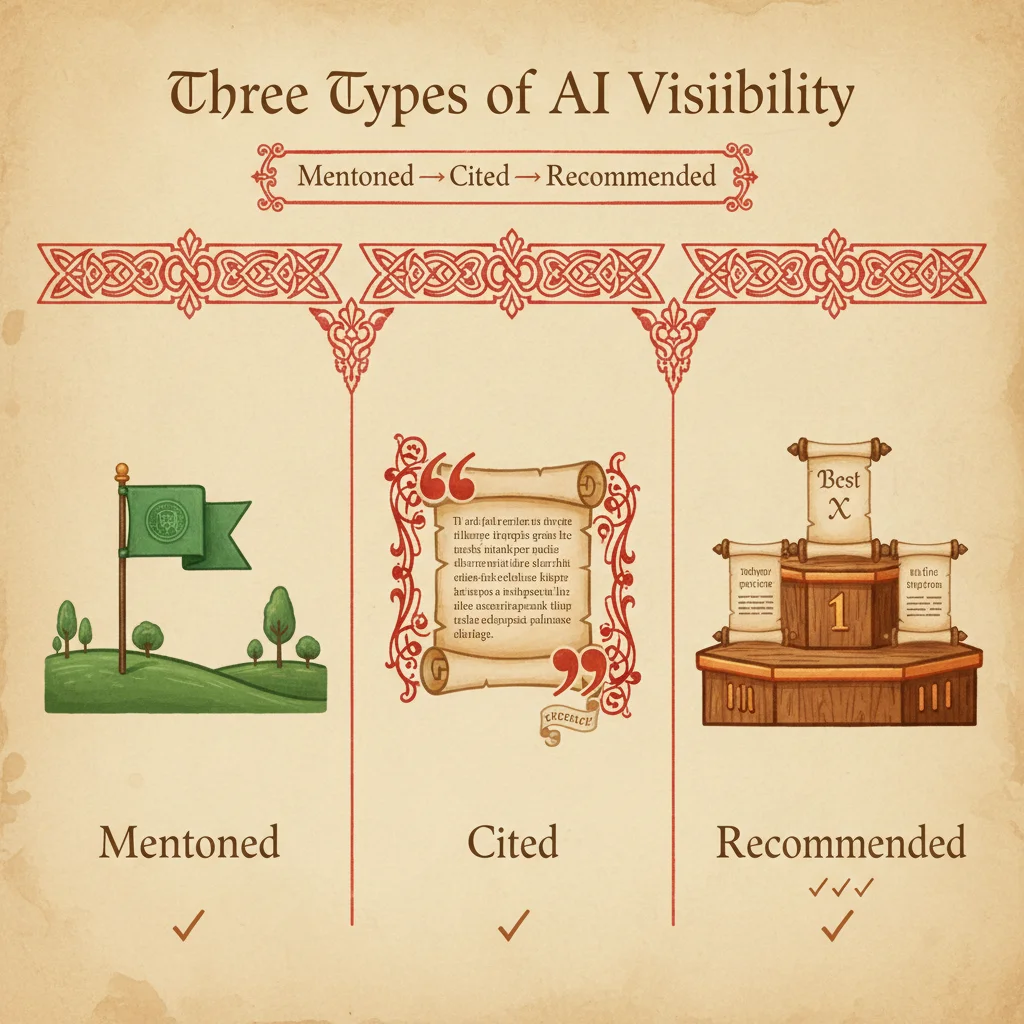
There are three outcomes worth tracking:
- Mentioned: Your brand or product appears in the answer
- Cited: The model quotes your content with attribution
- Recommended: You show up in a “best X” or “top X” list
Each requires different assets. Being mentioned requires brand presence across sources. Being cited requires quotable, extractable content. Being recommended requires corroboration in directories, comparisons, and reviews.
Most “SEO prompts for ChatGPT” produce blog copy. The prompts in this guide produce visibility audit logs, citable content blocks, and distribution tickets.
“Perfect prompting strategists and prompt aggregators vibe like witches writing spell books now.” — r/PromptEngineering commenter
Fair enough. The only prompts that “work” are prompts you rerun weekly, prompts that output something your team can ship, and prompts with a way to measure the delta.
What makes a prompt “work” (and why most don’t)
A prompt works if it creates a decision you can repeat and measure. Not a paragraph you paste once.
Most prompt libraries fail because:
- Inputs are missing: The prompt asks for “your product” but doesn’t require a claim ledger, criteria library, or proof bank
- Output format is loose: Prose is hard to ship; tables and JSON are actionable
- There’s no QA gate: You paste the output, publish, and hope
Good prompts are spec-first:
| Component | Purpose |
|---|---|
| Required inputs | What the prompt needs to produce specific, defensible output |
| Constraints | Guardrails (word count, no unsupported claims, force citations) |
| Output schema | Tables, JSON, or structured formats that map to tickets |
| “Unknown allowed” | Let the model say “insufficient data” instead of hallucinating |
When a prompt “works,” your team ships something that makes you more citable. Not more content. More citation gravity.
“I feel lost about all of these AI visibility tools.” — r/GenEngineOptimization commenter
The fix isn’t another dashboard. It’s separating tracking from the work: measure visibility, ship citable blocks and off-site corroboration, then re-measure.
Start here: the weekly ChatGPT visibility audit prompt
Before you generate anything, you need to know which queries you’re losing.
This prompt creates a weekly scorecard. Run it every Monday with the same query set, and you’ll have a visibility baseline you can track over time.
The scorecard schema
| Column | What it captures |
|---|---|
| Query | The search query or question |
| Intent | Informational, commercial, navigational |
| Mentioned | Is your brand mentioned? (yes/no) |
| Cited | Is your content quoted with attribution? (yes/no) |
| Recommended | Are you in a “best X” list? (yes/no) |
| Cited URLs | Which sources get quoted? |
| Competitors | Who else appears? |
| Confidence notes | Model uncertainty or caveats |
Template 1: The weekly audit prompt
You are an AI visibility analyst. I will give you a list of queries relevant to [YOUR BRAND/PRODUCT]. For each query, simulate how you would answer it today and score our visibility.

**Required inputs:**
- Brand name: [YOUR BRAND]
- Domain: [YOUR DOMAIN]
- Query list: [YOUR 10-20 TARGET QUERIES]

**For each query, output a table row with:**
1. Query
2. Intent (informational/commercial/navigational)
3. Mentioned (yes/no)
4. Cited (yes/no)
5. Recommended (yes/no)
6. Cited URLs (list the sources you'd pull from)
7. Competitors (other brands mentioned)
8. Confidence notes (your uncertainty about this answer)

**Constraints:**
- If you don't have enough information, write "insufficient data"
- Do not make up URLs or citations
- Be explicit about when a query would trigger a "best X" style list

**Output format:** Markdown table
The weekly deliverable
After running this prompt, you’ll have two lists:
- Top 10 citation gaps: Queries where competitors get cited and you don’t
- Top 10 recommendation gaps: Queries where you’re absent from “best X” lists
These become tickets. The audit prompt tells you where to focus. The next prompts help you build the assets to close those gaps.
Prompts that generate citable blocks (so ChatGPT can quote you)
AI models cite content they can extract. That means clear definitions, direct answers, and proof-dense blocks.
The Princeton GEO research found that specific tactics (citations, quotations, statistics) can boost visibility by up to 40%. Microsoft’s guidance on AI answer inclusion describes how content gets “parsed” into answer pieces.
Translation: if your page has generic paragraphs, AI has nothing to quote. If your page has extractable blocks, AI has something to cite.
Template 2: Definition box prompt
Generate a definition block for [TERM] that an AI model can extract and cite.

**Required inputs:**
- Term: [TERM]
- Context: [YOUR INDUSTRY/USE CASE]
- Proof sources: [2-3 AUTHORITATIVE URLS]

**Output format:**
> **[TERM] Definition**: [Clear, one-sentence definition that starts with "[TERM] is..."]
>
> [Supporting context in 2-3 sentences, citing the provided sources]

**Constraints:**
- Definition must be standalone (makes sense without surrounding text)
- Include at least one statistic or date
- Cite sources inline with hyperlinks
Template 3: FAQ answer prompt
Generate an FAQ answer for [QUESTION] optimized for AI citation.

**Required inputs:**
- Question: [QUESTION]
- Answer constraints: [MAX 100 WORDS]
- Sources: [1-2 URLS TO CITE]

**Output format:**
### [QUESTION]

[Direct answer in 1-2 sentences. Expand with evidence. End with a practical implication or next step.]

**Constraints:**
- First sentence must directly answer the question
- Include one statistic or quote with attribution
- No hedging in the first sentence
Template 4: Evidence strip prompt
Generate an evidence strip for [TOPIC] with 4-6 statistics an AI could cite.

**Required inputs:**
- Topic: [TOPIC]
- Stats with sources: [YOUR STATISTICS WITH URLS AND DATES]

**Output format:**
### What the research shows

- **[STAT 1]** — [Source](URL), [Date]
- **[STAT 2]** — [Source](URL), [Date]
- ...

**Constraints:**
- Every statistic must have a date
- Use only the provided sources (do not invent data)
- Format as a bullet list with bold lead-ins
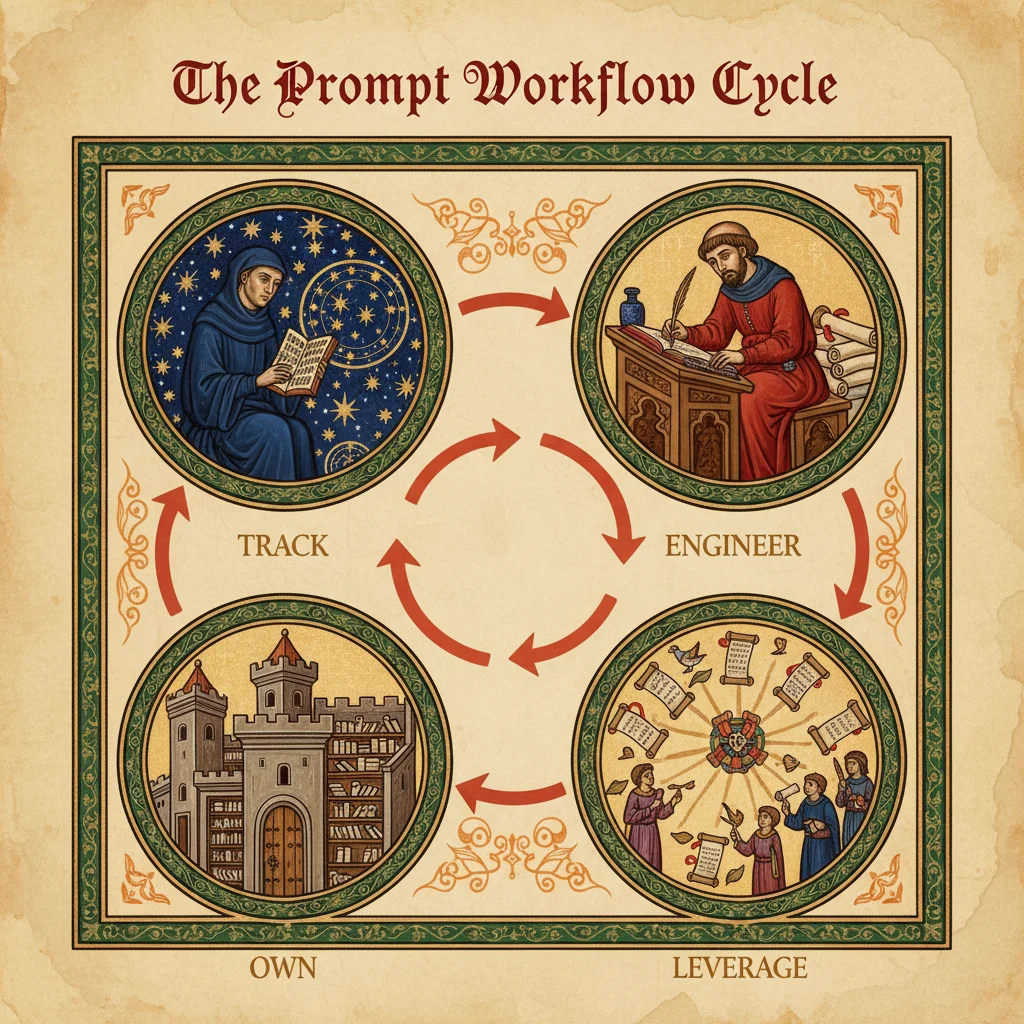
The operational reality: Understanding what makes content citable is table stakes. The execution—building extractable blocks across every page, tracking which ones get cited, engineering presence in communities and comparisons—is where most teams get stuck. That’s what we mean by Track → Engineer → Leverage → Own.
Prompts that turn answers into off-site assets
Your website is maybe 10% of what AI synthesizes from. The rest comes from directories, comparisons, reviews, and community discussions.
First Page Sage’s ChatGPT optimization guide positions this clearly: getting recommended requires changes both on and off your website. Listicles, directories, reviews, and social sentiment all contribute to recommendation pressure.
Template 5: Directory listing prompt
Generate a directory-ready description for [YOUR PRODUCT] that positions us for inclusion in "best [CATEGORY]" lists.

**Required inputs:**
- Product name: [PRODUCT]
- Category: [CATEGORY]
- Differentiators: [3 UNIQUE SELLING POINTS]
- Target directories: [LIST OF DIRECTORIES TO SUBMIT TO]

**Output format:**
**[PRODUCT] – [One-line positioning statement]**

[PRODUCT] is a [CATEGORY] that [PRIMARY BENEFIT]. Unlike [ALTERNATIVES], we [KEY DIFFERENTIATOR].

Key features:
- [Feature 1]: [Benefit]
- [Feature 2]: [Benefit]
- [Feature 3]: [Benefit]

**Constraints:**
- Under 150 words
- Include one proof point (customer count, metric, or founding date)
- No superlatives without evidence
Template 6: Comparison presence prompt
Generate a comparison framework that positions [YOUR PRODUCT] for "X vs Y" style queries.

**Required inputs:**
- Your product: [YOUR PRODUCT]
- Competitors: [2-3 COMPETITORS]
- Evaluation criteria: [5-7 CRITERIA YOUR AUDIENCE CARES ABOUT]

**Output format:**
| Criteria | [YOUR PRODUCT] | [Competitor 1] | [Competitor 2] |
|----------|----------------|----------------|----------------|
| [Criterion 1] | [Your advantage] | [Their position] | [Their position] |
...

**Positioning angles:**
- "Choose [YOUR PRODUCT] if you need [USE CASE 1]"
- "Choose [COMPETITOR 1] if you need [USE CASE 2]"

**Constraints:**
- Be honest about competitor strengths
- Use verifiable claims only
- Include a "why choose" decision framework
Template 7: Community answer prompt
Generate a Reddit/community answer for [QUESTION] that provides genuine value without sounding like marketing.

**Required inputs:**
- Question: [QUESTION]
- Subreddit/community: [COMMUNITY]
- Your relevant experience: [WHAT YOU CAN SHARE]
- Proof points: [EVIDENCE YOU CAN REFERENCE]

**Output format:**
[Direct answer to the question in conversational tone]

[Share relevant experience or data point]

[Mention your product/brand only if directly relevant, in context of what you learned]

**Constraints:**
- Sound like a practitioner, not a marketer
- Lead with value, not a pitch
- Include one specific detail that shows you've done this work
What you need before you prompt (inputs that prevent generic output)
Prompts aren’t magic. Inputs win.
The difference between generic AI output and defensible, citable content is what you feed the prompt. If your inputs are vague, your outputs will be too.
“Think of your content as a well-structured prompt that helps LLMs deliver fast, accurate answers to users.” — Jonathan Kvarford, Head of GTM Growth at Momentum
Input 1: Claim ledger
What you can say, with proof. Every claim needs a source, a date, and a confidence level.
| Claim | Source | Date | Confidence |
|---|---|---|---|
| “Our customers see 2x faster onboarding” | Case study (internal) | 2025-09 | High |
| “AI visibility improves conversions” | Stage 2 Capital quote | 2025-06 | Medium (single source) |
Input 2: Criteria library
How you evaluate “best” in your category. This prevents the prompt from inventing criteria.
| Criterion | Definition | Why it matters |
|---|---|---|
| Tracking depth | Which AI platforms are monitored | Can’t improve what you can’t measure |
| Citation detection | Does it show exact quotes or just mentions | Citation ≠ mention |
Input 3: Proof bank
Dated statistics and quotes you can paste into any prompt.
| Proof point | Source | URL | Date |
|---|---|---|---|
| 1.13B AI referrals in June 2025 | Similarweb | Similarweb AI News | 2025-07-29 |
| GEO methods boost visibility up to 40% | Princeton/arXiv | Princeton arXiv Paper | 2024-06-28 |
With these inputs, your prompts produce outputs that are specific, defensible, and citable.
Turn prompt outputs into a backlog you can own
The prompt pack is only valuable if it produces tickets and a weekly cadence.
Most AI visibility efforts fail because the output sits in a doc. Nothing ships. Nothing gets measured. Compare that to agencies charging $10,000/month for “ongoing monitoring and optimization.” You can build an ownership-first system that your team runs without the recurring fee.
Versioning
Store your prompt pack in a repo. Changes should be intentional and tracked. When you improve a prompt, you should be able to see what changed and why.
QA rubric
Before shipping any prompt output, check:
- Every statistic has a source and date
- No unsupported claims
- Output matches the spec (table/JSON, not prose)
- “Unknown” is stated where data is missing
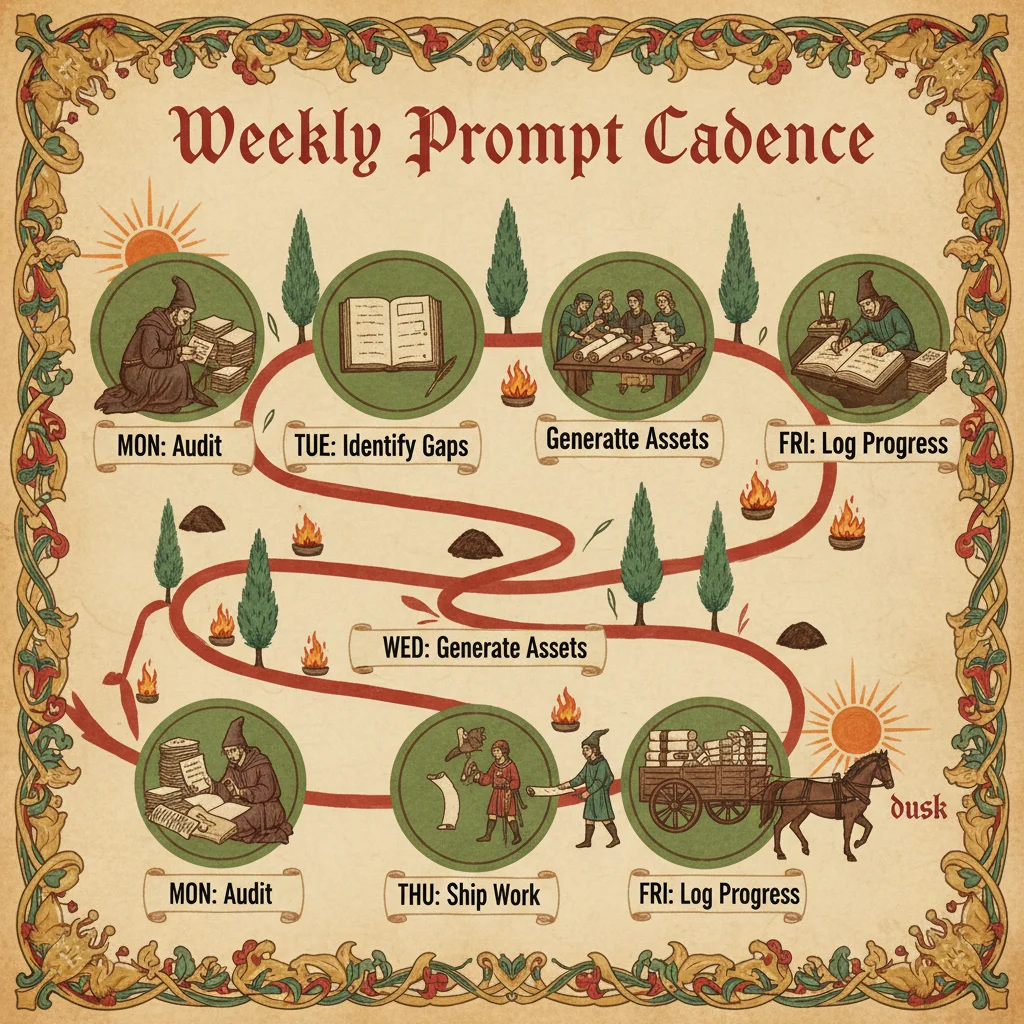
Weekly cadence
| Day | Action |
|---|---|
| Monday | Run the audit prompt with this week’s query set |
| Tuesday | Identify gaps; generate citable blocks for priority pages |
| Wednesday | Generate off-site assets (directory copy, comparison angles) |
| Thursday | Ship edits to production + submit off-site assets |
| Friday | Log what shipped; set up next week’s query set |
This isn’t complicated. It’s just not automatic. The prompts produce the raw material; your team ships the work.
How to validate progress
Analytics is incomplete. Most LLM referrals show up as homepage or direct traffic.
“ChatGPT does tag itself and is making efforts to add more tracking. Occasionally, you’ll see it in GA. But most of the time, LLM referrals show up as homepage traffic.” — Chris Long, VP of Marketing at Go Fish Digital
So don’t pretend you have precision. Treat your audit prompt as the source of truth for visibility, and use traffic signals as directional support.
Primary metric: Re-run the same query set with the same audit prompt. Track deltas: new citations, new sources pulled, new recommendation lists.
Directional signals: AI referral traffic (when visible), branded search volume, conversion rate from low-intent pages that get cited.
If your audit shows more citations week-over-week and your traffic holds, you’re making progress.
Schema: parsing support, not the whole game
There’s a recurring question in r/TechSEO: “Does extensive Schema markup actually help Large Language Models understand your entity better, or is it just for Google Rich Snippets?”
The honest answer: schema helps machines parse your content. It reduces ambiguity about entities, relationships, and data types. Microsoft’s AI answer inclusion guidance emphasizes that content needs to be “parsed” into answer pieces.
But schema doesn’t replace:
- Clear, quotable answer blocks
- Proof density (statistics, expert quotes, citations)
- Off-site corroboration (directories, reviews, community presence)
Treat schema as parsing support. The selection pressure that determines who gets recommended still favors clear answers plus proof plus corroboration.
Common mistakes (the fast way to waste a month)
The most common failure mode is mistaking a prompt output for shipped work.
Mistake 1: Prompting without required inputs
If you don’t have a claim ledger, criteria library, and proof bank, your outputs will be generic. No amount of clever prompting fixes vague inputs.
Mistake 2: Not forcing output schemas
Prose is hard to ship. Tables and JSON map directly to page edits and tickets. Always force structured output.
Mistake 3: Treating schema as the primary lever
Schema helps parsing. It doesn’t manufacture authority. Prioritize extractable answer blocks and proof density first.
Mistake 4: Measuring only traffic and ignoring presence
AI referrals are incomplete in analytics. Your audit prompt is the leading indicator. Traffic is a lagging (and noisy) signal.
Ready to see where you’re invisible?
We’ll run your key queries through ChatGPT, Perplexity, and Google AI Overviews and show you exactly where competitors get cited and you don’t. Takes 30 minutes.
Get your AI visibility audit →
Frequently Asked Questions
How do you know when ChatGPT is mentioning your brand? Specifically what queries?
You don’t get referrer data like traditional search. The practical answer is to run audit prompts weekly with your target query set and track whether you’re mentioned, cited, or recommended. Some AI visibility tools automate this, but you can start with manual prompt-based audits.
What are you using to report ChatGPT mentions?
Most teams use a combination of: (1) prompt-based audits run weekly, (2) brand monitoring tools that track AI outputs, and (3) referral traffic when visible. There’s no perfect solution yet. The audit prompt in this guide gives you a repeatable baseline that doesn’t depend on any specific tool.
ChatGPT is clearly sending visits but analytics shows nothing. Why?
Chris Long from Go Fish Digital explains it: “Most of the time, LLM referrals show up as homepage traffic.” ChatGPT is making efforts to add tracking, but attribution remains incomplete. Use your audit prompt as the primary visibility metric and treat traffic as a directional signal.
How do LLMs read websites? Is a certain website structure working well for LLM visibility?
LLMs parse content into extractable pieces. According to Microsoft’s guidance, content should be structured so it can be “parsed” into answer segments. In practice: use clear headings, direct answer blocks, definition boxes, FAQ formats, and evidence strips. Schema helps with parsing; extractability and proof density drive citations.
Does extensive Schema markup actually help LLMs understand your entity better?
Schema helps machines parse your content and reduces ambiguity. But it’s parsing support, not the main lever. The Princeton GEO research found that citations, quotations, and statistics boost visibility up to 40%. Schema makes your content easier to read. Proof density and extractable answer blocks make it worth citing.
Putting it together
The best SEO prompt for ChatGPT isn’t a single prompt. It’s a small pack that produces:
- A weekly audit (so you know which queries you’re losing)
- Citable blocks (definitions, FAQs, evidence strips)
- Off-site assets (directory listings, comparison angles, community answers)
- A backlog and cadence (so your team ships and re-measures)
Understanding prompts is the foundation. The operational work—building presence across channels, tracking deltas, shipping tickets—is where most teams get stuck.
Key takeaways:
- Run an audit prompt weekly to track mentions, citations, and recommendations
- Generate extractable blocks AI can quote, not generic blog copy
- Build off-site presence: directories, comparisons, community answers
- Own your prompt pack and cadence; don’t rent another tool
Related Articles
- ChatGPT SEO: Complete Guide
- 50 ChatGPT SEO Prompts That Work
- AI-Readable Writing Style
- The Definitive Guide to GEO
Typescape makes expert brands visible everywhere AI looks. Get your AI visibility audit →