How to Do GEO: Step-by-Step Guide
A practical GEO workflow: build deep answer pages, add proof, distribute off-site, then measure citation share with a repeatable 90-day cadence.

Author
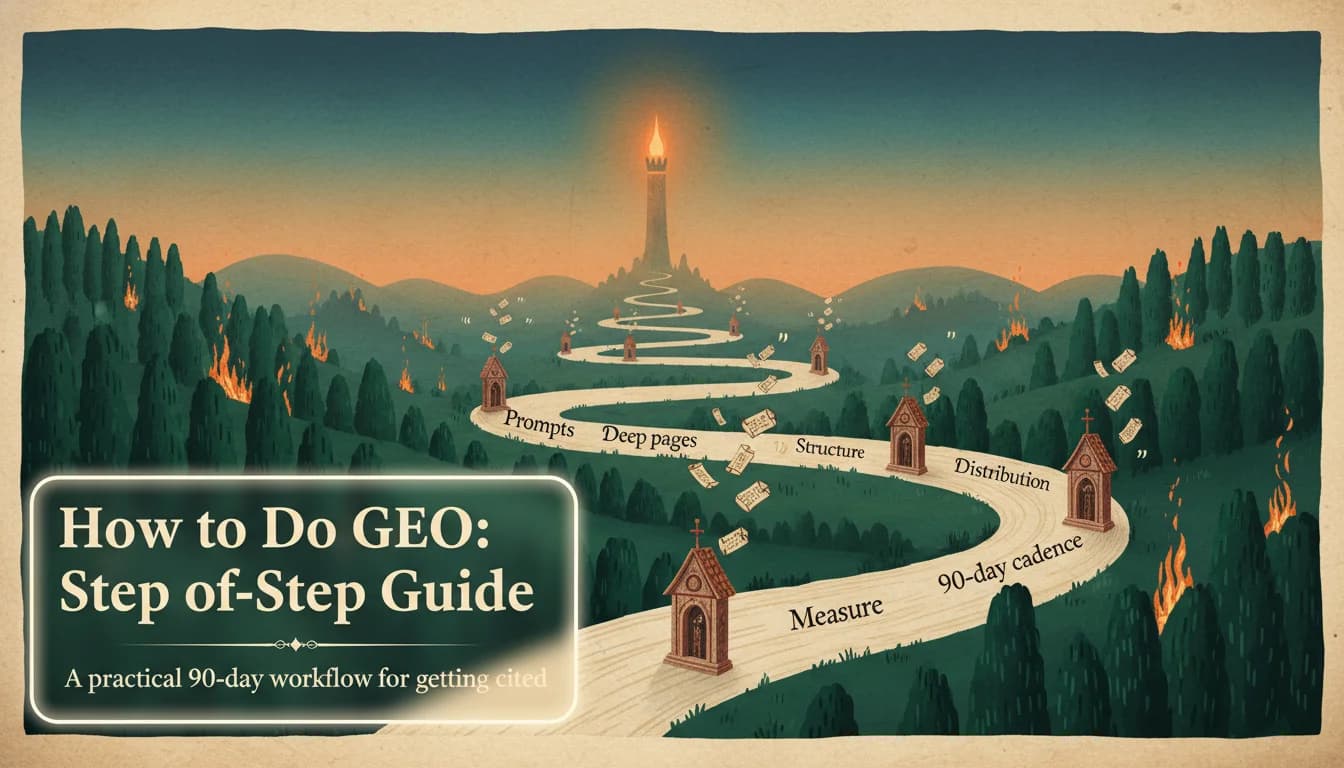
How to Do GEO: Step-by-Step Guide
There is no Search Console for ChatGPT.
If you've been waiting for Google to hand you a dashboard that shows which prompts cite your brand, you'll be waiting a long time. GEO only works if you run it like ops: ship pages, distribute them, measure what you can, then do it again.
Here's the uncomfortable reality: AI answers are eating clicks. Pew Research found that users who encountered an AI summary clicked on a traditional result in just 8% of visits, compared to 15% without the summary. The attention is moving inside the answer. Being cited inside that answer is now the game.
Understanding GEO is the easy part. The hard part is building the deep, citation-ready footprint (on-site and off-site) that AI keeps pulling from, then running measurement and refresh cycles until you actually start getting cited.
This guide gives you a step-by-step playbook: what to build, where to distribute, and how to measure progress when answers vary. No dashboards required. No magic files. Just an operator loop you can run with a small team and a 90-day cadence.
What is GEO, and what are you actually optimizing for?
GEO (Generative Engine Optimization) is the work of increasing the odds that generative engines cite or use your content when they assemble answers.
That's it. No mystical "prompt engineering." No secret schema. Just better content, better proof, and a wider footprint so AI has no choice but to pull from you.
GEO is still built on SEO fundamentals. But the unit of competition shifts. You're no longer just competing for "page ranks." You're competing to have your passage lifted into an answer.
Here's why that matters: when a user asks an LLM a question, the engine often performs multiple sub-queries behind the scenes. Exploding Topics explains it well: "An LLM can perform many different searches in the background when answering your question." One user prompt can trigger many retrieval calls. If your content is deep enough, you can win multiple slots.
The practical goal is simple: win citation share for a small set of prompts tied to your pipeline. Not every prompt. The ones that matter.
"Through rigorous evaluation, we demonstrate that GEO can boost visibility by up to 40% in generative engine responses."
For a deeper dive into the category, see our Definitive Guide to GEO.
A simple definition you can reuse
Generative Engine Optimization (GEO): The practice of creating and structuring content so that generative AI engines are more likely to cite, quote, or recommend it when assembling answers.
The difference from classic SEO: you're not just trying to rank a page. You're trying to have a passage extracted from that page and surfaced inside an AI-generated answer.
Step 1: Pick the prompts you want to win
Stop tracking random prompts. Start with a map.
Build a prompt set with three buckets:
- Branded prompts — "What is [Your Company]?" or "[Your Company] vs [Competitor]"
- Competitive prompts — "Best [category] for [use case]" or "[Competitor] alternatives"
- Informational prompts — "How to [thing your audience asks]" or "What is [concept in your space]"
Pick 10-20 prompts per bucket. For each prompt, define what "winning" looks like:
- Mentioned — Your brand appears in the answer
- Cited — A link to your domain appears
- Recommended — You're positioned as the answer or the option to try
The reality is that the same prompt can yield different answers at different times. Treat your prompt results as sampling, not ground truth.
One practitioner on r/SEO put it bluntly: "...we have no reliable method of tracking if our efforts worked. ... even the same prompts give different answers at different times."
That's not a bug. That's the operating environment. You work with probability, not certainty.
Prompt map template
| Prompt | Intent | Engines | Currently cited domains | Your target URL | Status |
|---|---|---|---|---|---|
| "Best [category] for [use case]" | Evaluation | ChatGPT, Perplexity, Google AIO | competitor.com, reddit.com | /comparison-page/ | Not cited |
| "How to [solve problem]" | Informational | ChatGPT, Perplexity | blog.competitor.com | /how-to-guide/ | Mentioned |
| "[Your Company] review" | Branded | ChatGPT, Perplexity | g2.com, capterra.com | /about/ | Cited |
Build your map. Update it monthly. This is your scoreboard.
Step 2: Build deep "answer pages"
AI Overviews don't cite homepages. They cite deep content.
Search Engine Land analyzed BrightEdge data and found that 82.5% of AI Overview citations linked to deep content pages. Only 0.5% linked to homepages.
That stat should change how you allocate resources. Your homepage is not an answer page. Build depth instead.
For each prompt in your map, create a dedicated target page (or section) that can be cited directly:
- FAQ hubs for the category
- How-to guides tied to prompts
- Glossary pages that define terms
- Comparison pages for evaluation intent
- Template/checklist pages for implementation intent
Make the page text-first, fully crawlable, and internally linked to related pages.
There's another factor: AI engines show a strong affinity for certain source types. Search Engine Land's analysis of 8,000 citations found that "Google's engines show a strong affinity for Reddit."
That's a clue. AI doesn't just cite your domain. It cites wherever the answers live.
Minimum viable deep-page set (weeks 1-4)
Start with:
- FAQ hub for your category — Answer the 10-15 questions your audience actually asks
- 3-5 answer pages tied to your highest-priority prompts
- 1 comparison page if your category has evaluation intent (e.g., "[Your Product] vs [Competitor]")
Ship these first. Then expand.
Step 3: Increase proof density
Deep pages are table stakes. The next lever is why AI should trust you more than the other ten pages answering the same question.
The answer: proof density.
Add primary-source citations, quotable expert lines, and specific stats directly in the sections that answer the prompt.
The Princeton GEO research found that adding citations and statistics significantly improved visibility in AI responses. Foundation's breakdown of that research put it plainly: "It turned out that simple methods like keyword stuffing didn't work well, but adding stats and quotations showed a significant performance improvement."
Proof density is an input you can control.
Here's what matters:
- Prefer primary sources — Link to official docs, academic research, and research organizations. Re-quoting other blogs doesn't add authority.
- Make proof easy to lift — Put the citation adjacent to the claim. Don't bury stats in a references section.
- Be specific — "40% improvement" beats "significant improvement." Dates beat "recently."
Proof checklist (per section)
For each major section of your answer page, include:
- 1 statistic with date and source link
- 1 quote with attribution and source link
- 1 concrete example or counterexample
This is where leveraging your SMEs pays off. A single 30-minute interview with a subject matter expert can yield 10+ quotable lines and unique data points that no competitor has.
Step 4: Structure content so AI can extract it
Proof makes you credible. Structure makes you extractable.
Here's the mental model: treat your page like an API contract.
- Headings = endpoints — Question-based H2s and H3s tell the AI what the section answers
- Answer capsules = response payloads — Put a 1-2 sentence direct answer immediately under each heading
- Tables and lists = typed fields — Package atomic facts so they can be lifted cleanly
Search Engine Journal makes this distinction clear: "Structured data is optional. Structured writing and formatting are not."
Schema markup is nice to have. But if your content is a wall of text with vague headings, no amount of JSON-LD will save you.
Here's the pattern:
Question-based heading:
## How long does GEO take to show results?Answer capsule (1-2 sentences, direct answer):
GEO typically takes 60-90 days to show measurable citation improvements.
Results depend on your starting footprint and the competitiveness of your prompts.
Expansion (proof, examples, nuance):
[Stats, quotes, examples with citations]This structure makes your content "liftable." AI can extract the answer capsule as a standalone fact. That's the goal.
Formatting that helps liftability
- Bullet lists for features, steps, or comparisons
- Numbered lists for processes or rankings
- Tables for structured comparisons
- Bold key terms where they first appear
- Short paragraphs (2-4 sentences max)
Step 5: Expand your footprint where AI learns
On-page work is necessary but not sufficient.
If AI also cites Reddit threads and listicles, your next job is building presence off your domain.
The 8,000-citation analysis found that Google's engines show a strong affinity for Reddit. That's not an accident. Reddit threads are dense with real user opinions, specific questions, and genuine answers.
One r/SEO practitioner summed it up: "...structuring the content on your website is a great start, but syndicating that content is more important..."
Treat distribution as part of GEO, not "extra marketing."
Priority off-site channels:
- Communities — Reddit, Quora, industry forums. Answer questions where they're asked.
- Comparisons — Get included in "best of" listicles and comparison articles in your category.
- Editorial mentions — Guest posts, expert quotes, podcast appearances that link back.
- Directories — Industry-specific directories and review sites.
The goal is the same as on-site: build deep coverage for the narrow questions your audience asks, but do it where AI already looks.
Step 6: Measure GEO without pretending it's precise
You can't measure GEO like you measure SEO. There's no Search Console for ChatGPT.
But you can build a measurement system that's useful, even if it's not precise.
Use three layers:
Layer 1: Prompt sampling
Re-run your prompt set on a schedule (weekly or bi-weekly). For each prompt:
- Run 3-5 samples across ChatGPT, Perplexity, and Google AI Overviews
- Record: which domains are cited, whether you're mentioned, whether you're linked
- Track changes over time
This is sampling, not census. Treat it like polling data: directionally useful, not ground truth.
One practitioner on r/SEO put it well: "Most tools are still half-baked because there's no search console for ChatGPT."
Accept that reality. Build a sampling workflow anyway.
Layer 2: Referral traffic
Track referral traffic from AI sources in your analytics. This is the least-gameable metric.
In GA4, look for referral traffic from:
chat.openai.comperplexity.ai- Direct traffic spikes that correlate with AI answer visibility
This is real: people clicked through from an AI answer to your site. That's signal.
Layer 3: Conversions and pipeline
The ultimate truth is downstream: did someone who came from an AI source convert?
Track AI-assisted conversions. If your citation share is increasing and your AI-referred pipeline is growing, the system is working.
Being cited matters because it correlates with clicks. Seer Interactive found that when you're cited in an AI Overview, you get 35% more organic clicks and 91% more paid clicks compared to when you're not cited.
Citation share isn't vanity. It's upstream of revenue.
Weekly measurement checklist
- Re-run prompt set (3-5 samples per prompt)
- Record: cited domains, your presence (mentioned/cited/linked), changes
- Pull AI referral traffic from analytics
- Check AI-assisted conversions
- Update prompt map with status changes
Step 7: Run a 90-day GEO cadence
GEO isn't a project. It's a system.
You improve when you ship on a cadence: weekly publishing, monthly refresh, quarterly expansion.
Here's a high-level 90-day plan:
| Week | Deliverables | Measurement | Decision |
|---|---|---|---|
| 1-2 | Pick prompts, baseline citations, ship first 2-3 deep pages | Initial prompt sampling | Which prompts to prioritize |
| 3-4 | Ship FAQ hub + 2 more answer pages | Week-over-week citation changes | Where to add proof |
| 5-6 | Add proof density to existing pages, answer capsules | Prompt sampling + referral traffic | Which pages need restructuring |
| 7-8 | Ship comparison page, start off-site distribution | Citation share by source type | Where off-site matters most |
| 9-10 | Expand off-site presence (communities, directories) | Referral traffic growth | Which channels to double down |
| 11-12 | Full refresh of top pages, plan next quarter | Full prompt audit + conversion review | Next quarter's prompt set |
One important guardrail: don't overclaim what's possible. Google Search Central is explicit: "There are no additional requirements to appear in AI Overviews or AI Mode, nor other special optimizations necessary."
GEO isn't a secret trick. It's doing SEO fundamentals well, adding proof and structure, expanding your footprint, and running the measurement loop.
And a reality check on expectations: even when you rank first in an AI Overview, you're not getting Position 1 clicks. Search Engine Land found that "ranking first in an AI Overview delivers roughly Position 6 clicks."
The game has changed. Presence inside the answer is the new table stakes.
What GEO is not (and what we won't claim)
Before you start, know what to ignore. Most GEO advice fails because it pushes fake certainty.
GEO is not a magic file. There's no schema or robots.txt directive that unlocks AI citations. Structured data helps. But structured writing matters more.
GEO is not a dashboard. Tools that show "your AI visibility score" are useful for sampling, but they're not ground truth. The prompts are synthetic. As one r/bigseo skeptic put it: "The prompts are synthetic ... none of these tools can actually show you what prompts are used ... The REAL number is referral traffic."
Use dashboards for directional signal. Trust referral traffic and conversions for ground truth.
GEO is not a guarantee. No one can promise AI citations. AI is a black box. What you can do is the work that makes citations more likely: deep pages, proof, structure, footprint, and a cadence that compounds.
GEO is not separate from SEO. Google says there are no additional requirements for AI Overviews beyond SEO basics. GEO is SEO executed well, with extra attention to extractability and proof.
Frequently Asked Questions
Is GEO different from SEO?
GEO is built on SEO fundamentals, but the outcome shifts. Instead of competing for "page ranks," you're competing to have your passage cited inside AI-generated answers. That rewards deep pages, extractable structure, and proof density. The tactics overlap, but the success metric is different.
Does Google say there are special optimizations for AI Overviews?
No. Google Search Central explicitly states: "There are no additional requirements to appear in AI Overviews or AI Mode, nor other special optimizations necessary." Do SEO well. Add proof and structure. That's the playbook.
How do I measure GEO if the same prompt gives different answers?
Treat it like sampling. Define a prompt set, re-run it on a schedule (weekly or bi-weekly), and combine that with referral traffic from AI sources and downstream conversions. You won't get a Search Console-style dashboard, but you can build a system that shows directional progress.
Are AI Overviews killing clicks?
AI summaries correlate with lower click-through to traditional results. Pew Research found that users clicked on traditional results 8% of the time when an AI summary appeared, compared to 15% without. But being cited inside that summary matters: Seer Interactive found that cited pages get 35% more organic clicks than uncited pages in the same AI Overview.
What should I build first for GEO?
Start with deep answer pages tied to your prompt set: FAQ hubs, how-to guides, and one comparison page if your category has evaluation intent. BrightEdge data shows that 82.5% of AI Overview citations link to deep pages. Build depth before breadth.
If I get cited, does it actually help?
Yes. Being cited correlates with higher click-through. Seer Interactive found a 35% lift in organic CTR and a 91% lift in paid CTR when you're cited versus when you're not. Citation share is upstream of revenue.
Start building your GEO system
GEO isn't a tactic you apply once. It's a weekly system that compounds.
Here's the loop:
- Pick a prompt set tied to pipeline
- Build deep answer pages with proof and structure
- Distribute where AI learns (communities, comparisons, editorial)
- Measure with sampling + referrals + conversions
- Refresh and expand on a 90-day cadence
The work is operational. It requires deep pages, SME time for proof, off-site distribution, and a measurement discipline that accepts uncertainty. Most teams get stuck because they treat GEO as a one-time content tweak instead of an ongoing system.
That's where the real leverage is: building a footprint so wide and so deep that AI has no choice but to pull from you. Then running the cycle until citations start compounding.
Ready to see where you're invisible? Check if your brand appears in ChatGPT, Perplexity, and Google AI Overviews →
Want monthly updates on what's working? Get our monthly AI Search Updates →