What is AI Visibility? (And Why It Matters in 2026)
AI visibility is how often your brand appears in ChatGPT, Perplexity, and Google AI answers. Learn why 80% of AI citations come from outside Google's top 100, and how to get cited.

Author
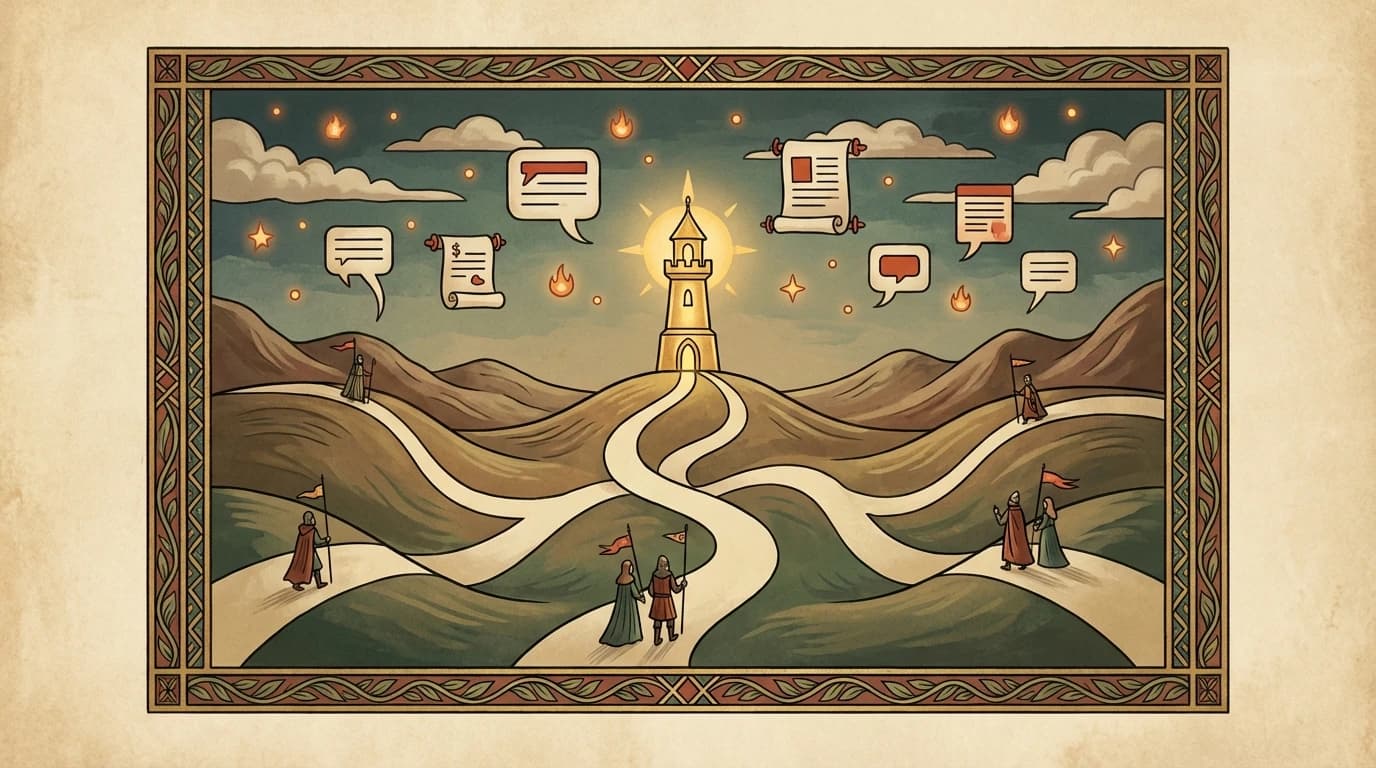
What is AI Visibility?
AI visibility is the measure of how accurately, frequently, and favorably your brand appears when AI systems answer questions in your domain. Unlike traditional search visibility measured in rankings, AI visibility is measured in citations and recommendations across platforms like ChatGPT, Perplexity, Google AI Overviews, Claude, and Microsoft Copilot.
The distinction matters: you're no longer competing to rank on a results page. You're competing to be synthesized into the answer itself.
Key takeaways:
- AI visibility means being cited and recommended by AI, not just ranking on search engines
- Over 2 billion people now use generative AI; ChatGPT alone processes 1 billion+ daily queries
- 80% of what AI cites doesn't come from the top 100 Google results
- Princeton research shows 30-40% visibility improvement is possible with the right optimization tactics
The bottom line: If AI doesn't mention you when someone asks about your category, you're invisible to a growing share of your audience.
Why AI Visibility Matters Now
The way people find information has fundamentally changed. AI isn't coming for traditional search; it's already here, processing billions of queries daily.
Consider the numbers:
- 47% of Google searches now show AI Overviews
- Users are 47% less likely to click a traditional result when an AI answer appears
- ChatGPT commands 81% of the AI chatbot market with 800 million weekly active users
- Gartner predicts a 25% drop in traditional search volume by the end of 2026
- According to ConvertMate's 2026 AI Visibility Study, 67% of information discovery will occur through LLM interfaces by 2026
The shift isn't gradual. According to a 2025 Consumer Trust Index, 42% of consumers already trust AI recommendations as much as recommendations from human experts. And the conversion data is even more striking: users who search with LLMs are 4.4x more likely to convert than those using traditional search engines.
If your competitors show up when someone asks ChatGPT "best [your category] tools" and you don't, that's not a branding problem. That's a visibility problem.
Most companies don't know where they're invisible. AI visibility tracking shows exactly which queries cite you, which cite competitors, and where you're missing entirely. Without measurement, you're optimizing blind.
The stakes compound over time. Research shows that brands in the top 25% for web mentions get 10x more AI visibility than others. The gap between visible and invisible brands is widening, not narrowing.
How AI Visibility Differs from Traditional SEO
The instinct is to treat AI visibility like SEO with a new name. It's not.
| Traditional SEO | AI Visibility |
|---|---|
| Optimizes for rankings | Optimizes for citations |
| Focuses on your website | Requires presence everywhere |
| Success = page 1 position | Success = mentioned in the answer |
| Measured in clicks | Measured in brand mentions |
Here's the insight that changes everything: 80% of URLs cited by AI don't rank in Google's top 100 results for that query. AI isn't looking at the same leaderboard SEO has trained us to watch.
Research from Birdeye found that brands are 6.5x more likely to be cited through third-party sources (Reddit threads, comparison articles, forums, directories) than through their own primary domains.
This doesn't mean SEO is dead. GEO (Generative Engine Optimization) is additive to SEO, not a replacement. The companies winning in AI search are doing both. Traditional SEO still matters for organic traffic. But for the growing audience that asks AI directly, your website ranking is almost irrelevant.
Your website is maybe 10% of the equation. The other 90% is what people say about you everywhere else.
How AI Engines Decide What to Cite
AI doesn't rank pages. It synthesizes answers from what it finds across its training data and real-time retrieval. Different platforms have different preferences.
ChatGPT behaves like "a very serious professor," according to DataDab's analysis. It prefers conceptual clarity, structured frameworks, and well-organized information. Wikipedia is its most-cited source at 7.8%, demonstrating a preference for encyclopedic, factual content.
Perplexity is "obsessed with freshness and link authority." It cites the most recent, most structured, most data-dense pages. If your content isn't clearly updated, Perplexity will deprioritize it. Reddit dominates Perplexity citations at 46.7% in some analyses.
Google AI Overviews favor user-generated content. They cite Reddit (21%) and YouTube (18.8%) most frequently, showing a strong preference for conversational, authentic sources.
The pattern across all platforms: AI cites what it finds everywhere, then synthesizes an answer. 90% of AI citations driving brand visibility come from earned and owned media, not paid placements.
One finding worth noting: websites with author schema are 3x more likely to appear in AI answers. E-E-A-T signals (expertise, experience, authority, trust) matter for AI just as they do for traditional search.
Understanding what AI prefers is table stakes. The hard part is building presence across every channel AI looks: communities, comparisons, backlinks, and your own domain. This is what we mean by engineering visibility, not just optimizing pages, but systematically building presence everywhere AI looks for answers.
How to Measure AI Visibility
Before you can improve AI visibility, you need to measure it. Unlike traditional SEO with clear ranking positions, AI visibility requires tracking multiple dimensions across multiple platforms.
Core Metrics
According to AirOps' measurement guide, the primary KPI is your Brand Visibility Score: the percentage of relevant AI answers that mention your brand. But that's just the starting point.
Track these additional metrics:
- Mention frequency - How often your brand appears in AI responses for target queries
- Citation quality - Whether AI directly quotes your content, paraphrases it, or mentions you in passing
- Competitor co-mentions - How often you appear alongside (or instead of) competitors
- Source attribution - Which of your pages AI cites most frequently
- Answer sentiment - Whether AI frames your brand positively, neutrally, or negatively
Manual vs Automated Tracking
Manual baseline testing: Query 20-30 industry-relevant questions across ChatGPT, Perplexity, Claude, and Google AI Overviews. Include branded queries ("What is [your company]?"), unbranded queries ("best tools for X"), and competitive comparisons. Document findings in a spreadsheet.
Automated monitoring: Tools like Otterly.ai, Profound, Peec AI, and Frase AI Visibility can track hundreds of queries across platforms automatically. The recommended cadence:
- Daily scans for critical brand and product terms
- Weekly audits for broader category queries
- Monthly competitive analysis for market positioning
The Volatility Problem
Here's what makes measurement challenging: AI responses change constantly. Research shows 70% of AI Overview content changes for the same query, and nearly half of citations get replaced when the answer updates.
Only 30% of brands stay visible from one answer to the next. This volatility means you can't measure once and assume you're done. Continuous monitoring is the only way to understand your actual visibility.
For updated pages, AirOps recommends re-running your query set every 7 days to capture the impact of content changes.
How to Improve AI Visibility
Princeton researchers introduced Generative Engine Optimization (GEO) in 2023, demonstrating that specific content tactics can boost AI visibility by 30-40%. Here's where to start:
1. Audit Your Current Visibility
Before optimizing, understand where you stand. Ask ChatGPT, Perplexity, and Claude questions your customers ask. Search for your category, your competitors, your use cases. Note which brands get mentioned and which don't.
Tools like Otterly.ai, Profound, and Frase can automate this tracking across platforms.
2. Structure Content for Citation
The Princeton study found that adding citations, quotations, and statistics significantly boosts visibility, achieving 30-40% improvement in their experiments. Traditional SEO tactics like keyword stuffing actually performed worse.
ConvertMate's 2026 research adds specificity: sites with H2-H3-bullet point structures are 40% more likely to be cited. Structured data implementation improves LLM discoverability by 67%.
Create content that AI can easily extract:
- Clear definitions in the first 100 words
- Specific statistics with sources
- Expert quotes with attribution
- Question-answer structures (FAQ schema helps)
- Numbered lists and frameworks
- Sequential heading hierarchy (H2 > H3 > bullets)
3. Build Presence Beyond Your Domain
Since 80% of citations come from sources outside the top Google results, you need presence where AI looks:
- Communities: Participate in Reddit discussions, industry forums, Q&A sites
- Comparisons: Get included in "best X" and "X vs Y" articles
- Directories: Ensure accurate listings in industry directories
- Reviews: Build presence on G2, Capterra, Trustpilot (for B2B)
Reddit alone appears in 23.6 million pages cited across AI platforms.
The multiplier effects are significant. According to ConvertMate's research:
- Brands with 10M+ Reddit mentions: 3.9x more citations (7.0 avg vs 1.8)
- Quora presence: 4.1x improvement potential
- Review platform presence: 2.6-3.5x multiplier
About 48% of citations come from community platforms like Reddit and YouTube, and 85% of brand mentions originate from third-party pages rather than owned domains.
4. Add Authority Signals
AI models weight credibility signals:
- Author schema markup (3x more likely to be cited)
- E-E-A-T signals throughout content
- External citations from authoritative sources
- Updated publication dates
ConvertMate's research found that brand search volume (not backlinks) is emerging as the strongest predictor of AI citations, with a 0.334 correlation. Building brand awareness through PR campaigns, earned media, and thought leadership directly improves AI visibility.
5. Keep Content Fresh
Content freshness has become a critical ranking factor for AI visibility. According to ConvertMate's 2026 study:
- Content updated within 60 days is almost twice as likely to appear in AI answers
- Pages not updated quarterly are 3x more likely to lose citations
- A 30-day refresh cycle provides a 3.2x visibility multiplier
This means your content calendar needs a maintenance component. Review and update your most important pages at least monthly, adding new statistics, refreshing examples, and ensuring accuracy.
6. Monitor and Iterate
AI responses are volatile. Research shows 70% of AI Overview content changes for the same query, and nearly half of citations get replaced when the answer updates. Only 30% of brands stay visible from snapshot to snapshot.
This isn't a one-time optimization. It's ongoing work.
Your experts' knowledge is the asset. Systematizing that extraction, and scaling it through AI-assisted workflows, is how small teams outproduce content factories. The constraint isn't budget; it's expert time.
Common Misconceptions About AI Visibility
"GEO replaces SEO"
No. GEO is additive to SEO, not a replacement. The companies winning in AI search are doing both. Traditional SEO still drives the majority of organic traffic. GEO captures the growing AI search audience.
"If I rank #1 on Google, AI will cite me"
Rarely. 80% of AI-cited URLs don't rank in Google's top 100. AI synthesizes from different sources than traditional search indexes.
"You can't influence what AI says"
Wrong. Princeton's GEO research demonstrates 30-40% visibility improvement with specific tactics. The mechanism is different from SEO, but optimization is possible.
"Only big brands get cited by AI"
Partially true. The top 50 brands receive about 28.9% of all mentions in AI Overviews. But third-party presence (communities, comparisons, reviews) matters more than raw domain authority. Smaller brands with strong community presence often outperform larger competitors.
"AI visibility is just another term for AI-generated content"
Different things entirely. AI visibility is about being cited by AI when users ask questions. AI-generated content is about using AI to create content. You can have one without the other.
The honest truth: no one can guarantee AI citations. AI models are black boxes, and responses change constantly. What we can guarantee is doing the work that makes citations possible, being present everywhere, with quality content, consistently.
FAQ
What's the difference between AI visibility and traditional SEO?
SEO optimizes your website for search engine rankings. AI visibility optimizes your entire footprint for AI citations, across your domain, communities, comparisons, directories, and any other source AI might reference. You can rank #1 on Google and still be invisible to ChatGPT if your presence is limited to your own website. For a deeper comparison, see AEO vs GEO differences explained.
How do I know if my brand is visible to AI?
Test it directly. Ask ChatGPT, Perplexity, and Claude questions your customers ask about your category. Search for product recommendations, comparisons, and how-to queries in your space. Note which brands get mentioned. For systematic tracking, tools like Otterly.ai and Profound monitor brand mentions across AI platforms automatically.
Is AI search actually affecting my traffic?
For most sites, AI referrals are still roughly 1% of total traffic, but they're growing faster than any other channel. The bigger impact is indirect: when AI Overviews appear, CTR drops 61% for traditional results. Users who get their answer from AI never click through to your site at all. Learn more about this shift in What Is Zero-Click Search?.
Can I optimize for both SEO and AI visibility?
Yes, and you should. The foundational work overlaps: quality content, expertise signals, authoritative sourcing. The tactics diverge: AI rewards citations and statistics over keyword density, and it weighs third-party presence more heavily than domain authority. Do both, but recognize they're different games. See How to Optimize Content for AI Search for tactical guidance.
Why does Reddit matter so much for AI visibility?
Reddit is the single most-cited domain aggregated across major AI platforms. AI treats authentic community discussions as expert sources. Over 23.6 million Reddit pages are cited in AI responses. If you're not participating in relevant subreddit discussions, you're missing where AI looks first.
How do I get my brand cited by ChatGPT?
Build presence beyond your own domain. Get mentioned in community discussions, comparison articles, directories, and review sites. Create structured, well-cited content that AI can easily extract. Add author schema and E-E-A-T signals. Then monitor your visibility and iterate. AI responses change frequently, so this is ongoing work, not a one-time optimization. The ChatGPT SEO Complete Guide covers this in depth.
What's the relationship between AI visibility and AEO/GEO?
AEO (Answer Engine Optimization) focuses on optimizing for any system that provides direct answers, including Google's featured snippets and AI assistants. GEO (Generative Engine Optimization) specifically targets large language models like ChatGPT, Perplexity, and Claude. AI visibility is the outcome metric for both: how often and how favorably your brand appears in AI-generated answers. GEO is the practice; AI visibility is what you measure. Learn the differences in AEO vs GEO explained.
How long does it take to improve AI visibility?
Expect 3-6 months to see significant improvement. Unlike SEO where you can track ranking changes relatively quickly, AI visibility changes depend on model updates, real-time retrieval improvements, and the accumulation of brand mentions across the web. Quick wins come from fixing obvious issues (outdated content, missing schema, no third-party presence). Sustained improvement requires consistent content investment and community engagement.
Is there a tool that measures AI visibility like Semrush measures SEO?
Several emerging tools track AI visibility specifically. Otterly.ai monitors brand mentions across ChatGPT, Perplexity, and Google AI Overviews. Profound tracks citation sources and competitor positioning. Semrush's AI Visibility Index launched in 2026 for enterprise-level tracking. Peec AI offers real-time AI search analytics. The space is maturing rapidly, with more tools launching quarterly.
What to Do Next
AI visibility isn't optional anymore. As AI becomes the primary way people find information, being invisible to AI means being invisible to your audience.
Three paths forward:
-
Learn the methodology - Read the Definitive Guide to GEO to understand how generative engine optimization works and where to focus.
-
Start with the basics - Follow the step-by-step GEO guide to implement foundational optimizations.
-
Compare your options - Review the GEO tools comparison to find the right tracking and optimization tools for your needs.
The shift is happening whether you optimize for it or not. The question is whether your brand will be part of the answer.
Related reading: